Teaching Philosophy
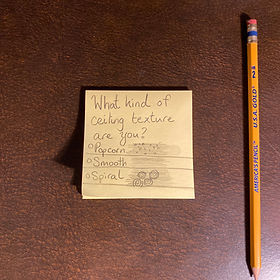
The first time I asked a class what kind of ceiling texture they would be (popcorn, smooth, or spiral), one student said, “Pop… no, wait. Definitely spiral. I overthink everything.” The room laughed, then turned thoughtful, and as we went around the room, each response was justified with a variety of metaphors, aesthetic preferences, and personality traits. That moment—unexpected, a little absurd, and surprisingly generative—captures the kind of intellectual flexibility I hope to instill in my students. I begin each session with a short attendance question; some are odd, like the one about ceilings, while others are more conventional (“What’s the best gift you’ve ever received?”). These questions are not merely icebreakers. They also model a three-part cognitive process I reinforce throughout the semester: ask rich, fruitful questions; connect new material to prior knowledge; and articulate informed conclusions in a space where playful risk-taking is encouraged. In that kind of environment, it becomes entirely acceptable, even productive, to say that you are a spiral ceiling.
This blend of play and reflection is emblematic of the kind of learning I value. I structure each lesson to accommodate a range of engagement modes and to guide students through a recursive process of investigation and application. A typical session might begin with students recalling experiences relating to that day’s topic (“Consider a time you had to achieve a compromise”; “What text(s) have challenged your values or beliefs?”). I follow this opening with a brief opportunity for students to share their responses. I then use these responses as a basis for an introduction to new material; I provide a lecture that connects their experiences to key terms and concepts. Students then apply those concepts in small-group activities or discussions, during which I check in with each group, field questions, and carefully steer conversations in productive directions. We then share our discoveries and conclusions in a whole-class synthesis discussion. Occasionally, I will ask them to once again reflect individually on the subjects we discussed and hand in those thoughts. Such small-stakes submissions allow me to gauge progress and retention of critical information.
In my writing classes, I often use literature to teach habits of mind that go beyond literary analysis. I use Louis Jenkins’s poem “Baloney,” for example, when I teach the process of discovery. The poem begins with an observation of young lovers and ends with a memory of a baloney sandwich as a porthole into another world; this sudden shift represents how meaning can emerge from a willingness to explore and be open to new possibilities. I then encourage students to try approaching research and writing the same way: to begin with questions and hypotheses over answers, and to take time to develop their arguments. Then, they can replicate that process in their writing to effectively guide their readers to their informed conclusions.
(Examples of attendance questions.)
I have also incorporated short literary excerpts to teach tone, voice, and revision. Even when literature is not the course’s focus, literary thinking shapes how we interpret language. I ask students to apply these concepts to situations that are familiar to them; they might write a letter requesting an extension on an assignment or find points of concession and accommodation in an argument with a disgruntled roommate. Drawing on such real-life contexts allows students to focus on developing form and presentation without being overwhelmed by unfamiliar subject matter. Throughout these activities, I act as a facilitator by asking questions, drawing connections, and helping students make their rhetorical decisions visible and intentional.
My courses are designed to foster student agency. In both literature and writing courses, I often structure my assignments to define the kind of work students will be performing—such as writing an analysis, an argument, or a manifesto—but leave enough room for students to use these structures to support their own avenues of inquiry. This balance helps students take ownership of their work and cultivates a sense of investment that mitigates the impulse to find shortcuts or use generative AI. A final project I often assign, the “unessay,” challenges students to present a researched argument through a creative, multimodal form of their choice: a short video, a board game, an original song, which is then accompanied by a reflective essay that explains their process. By articulating not only what they’ve argued but how they’ve constructed that argument, students develop crucial metacognitive awareness that serves them beyond the classroom.
Just as I teach students to consider and respond to the needs of their rhetorical audiences, I recognize that it is essential to meet students where they are. After the first unit, I invite students to complete an anonymous feedback form on course pacing and structure. I then make any necessary adjustments to respond to their expressed needs. For example, when students recently noted that scaffolding deadlines felt compressed, we negotiated a revised timeline that provided more drafting time without compromising feedback turnaround. I also assess participation holistically, validating contributions across formats: in-class discussion, small-group work, reflective writing, office hour engagement, and thoughtful email communication.
My pedagogical values—curiosity, flexibility, and responsiveness—shape my approach whether I’m teaching first-year composition, English literature, or comparative literature. I teach literature and rhetoric as tools for navigating the world with clarity, empathy, and imagination. Whether students are scanning a John Milton poem, identifying logical fallacies in a New York Times op-ed piece, or closely reading a passage from King Lear, they will leave the classroom having developed habits of inquiry and interpretation that extend far beyond it. These skills prepare them to think critically, communicate effectively, and engage meaningfully in the communities they inhabit.